Eberly College of Science
Nanoparticle opens the door to clean-energy alternatives
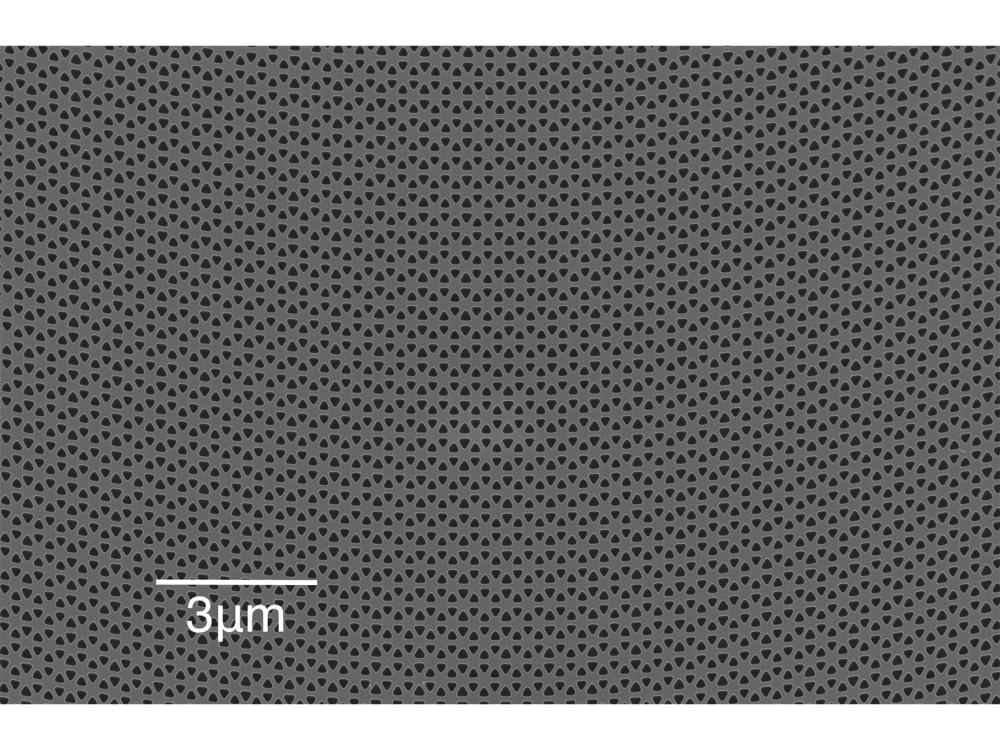
Cheaper clean-energy technologies could be made possible thanks to a new discovery. Research team members led by Raymond Schaak, a professor of chemistry at Penn State, have found that an important chemical reaction that generates hydrogen from water is effectively triggered -- or catalyzed -- by a nanoparticle made of nickel and phosphorus, two inexpensive elements that are abundant on Earth. The results of the research will be published in the Journal of the American Chemical Society. More details and two photos are online at http://science.psu.edu/news-and-events/2013-news/Schaak6-2013 .
Nuclear engineering student wins prestigious astronaut scholarship
Daniel Abercrombie, a senior in nuclear engineering and physics, is one of 28 students awarded a $10,000 scholarship from the Astronaut Scholarship Foundation.
Reprogrammed cells a new tool in researching Alzheimer's, schizophrenia, autism
Alzheimer's, schizophrenia, autism and other difficult-to-study diseases now can be probed more safely and effectively thanks to an innovative new method for obtaining mature brain cells from reprogrammed skin cells. The method was developed by a research team led by Gong Chen at Penn State. "The most exciting part of this research is that it offers the promise of direct disease modeling by the creation, in a Petri dish, of mature human neurons that behave a lot like the neurons that grow naturally in the human brain," said Chen, a professor of biology and the Verne M. Willaman Chair in Life Sciences at Penn State.
Science Seminars: June 10 to 17
Science Seminars for the week of June 10 are:
Monday, June 10
"Functional and Evolutionary Genomics of Plant Small RNAs," Zhaorong Ma, Penn State, 9 a.m., 519 Wartik Laboratory, adviser: Michael Axtell, The Huck Institutes of the Life Sciences (814-867-0241).
Thursday, June 13
"Roles of HDGF2 and OKL38 in Cell Growth, Apoptosis and DNA Damage Response," Jing Hu, Penn State, 9:30 a.m., 101 Althouse Laboratory, host: Yanming Wang, Department of Biochemistry and Molecular Biology (814-865-3775).
New kind of antibiotic may be more effective against tuberculosis, anthrax
Diseases such as tuberculosis, anthrax, and shigellosis -- a severe food-borne illness -- eventually could be treated with an entirely new and more-effective kind of antibiotic, thanks to a team of scientists led by Kenneth Keiler, an associate professor of biochemistry and molecular biology at Penn State. The team describes 46 previously untested molecules that target and disrupt an important step in the process of protein synthesis in bacteria, thereby making the bacteria incapable of replicating. This important step, known as "trans-translation," is a quality-control mechanism that is found in all species of bacteria. More information is online at science.psu.edu/news-and-events/2013-news/Keiler5-2013.
NASA Swift provides the best-ever UV view of the nearest galaxies
Astronomers at Penn State and NASA's Goddard Space Flight Center in Greenbelt, Md., have used NASA's Swift satellite to create the most detailed surveys of the Large and Small Magellanic clouds, the two closest major galaxies, in ultraviolet light.
Penn State controlled satellite captures best ultraviolet maps of two galaxies
The most detailed ultraviolet light surveys ever made of the two major galaxies that are closest to our own Milky Way, the Large and Small Magellanic Clouds, have been created by astronomers at NASA and Penn State.
Thomas Wartik, professor emeritus of chemistry and dean emeritus, dies at 91
Thomas Wartik, professor emeritus of chemistry and dean emeritus of the Penn State University Eberly College of Science, died on May 29, 2013, at Foxdale Village in State College at the age of 91.
American Public Health Association honors Debashis Ghosh
Debashis Ghosh, a professor of statistics at Penn State University, has been honored with the Mortimer Spiegelman Award of the American Public Health Association. The award will be presented at a meeting of the American Public Health Association later this year.
Super-dense star is first ever found suddenly slowing its spin
One of the densest objects in the universe, a neutron star about 10,000 light years from Earth, has been discovered suddenly putting the brakes on its spinning speed. The event is a mystery that holds important clues for understanding how matter reacts when it is squeezed more tightly than the density of an atomic nucleus -- a state that no laboratory on Earth has achieved.
State University of New York recognizes Rao with honorary degree
Penn State's C.R. Rao, Emeritus Holder of the Eberly Family Chair in Statistics, long recognized as one of the world's top statisticians, has been awarded an honorary doctorate degree from the State University of New York. He received the degree at the 167th commencement of the University at Buffalo earlier this year.
Science Seminars: May 27 to June 2
MONDAY, MAY 27
None
TUESDAY, MAY 28
"Polymer Electrolytes: Materials and Device Aspects," Rakesh Chandra Agrawal, Pandit Ravishankar Shukla University (India), 10 am, 301 Steidle Building, Department of Materials Science and Engineering (814-865-4992).
Mosquito behavior may be immune response, not parasite manipulation
Malaria-carrying mosquitos appear to be manipulated by the parasites they carry, but this manipulation may simply be part of the mosquitos' immune response, according to Penn State entomologists.
Getting to the bottom of the zombie ant phenomenon
Rainforest ecologist David Hughes has a special interest in parasites, especially those that accomplish their ends by mind control: invading the brain of a hapless host -- ants, in this case -- and causing that creature to do its bidding. Scientists like Hughes say 'zombie ants' offer new insights into the role behavior plays in spreading disease.
Pages
Probing Question: Do women dominate the field of forensic science?
Exhuming corpses, analyzing bloodstained clothing, collecting "crime scene insects" (yes, maggots)...these are some of the grittier realities of life as a forensic scientist. Yet defying the stereotype that females tend to be squeamish about such things, an entire generation of young women have become entranced by the profession. In fact, they've pursued this career in such numbers that—unlike almost every other scientific discipline—one could argue that the booming field of forensic science is a female domain.
Biting the Plant that Feeds You
She's part pilgrim and part vampire, purplish black and pear-shaped. Moments after her April birth, the aphid creeps along the smooth witch hazel leaf until she finds a suitable intersection of veins. She thrusts her needle mouth into the junction and begins to feed, sucking the sweet sap from the plant.
New kind of antibiotic may be more effective against tuberculosis, anthrax
Diseases such as tuberculosis, anthrax, and shigellosis -- a severe food-borne illness -- eventually could be treated with an entirely new and more-effective kind of antibiotic, thanks to a team of scientists led by Kenneth Keiler, an associate professor of biochemistry and molecular biology at Penn State. The team describes 46 previously untested molecules that target and disrupt an important step in the process of protein synthesis in bacteria, thereby making the bacteria incapable of replicating. This important step, known as "trans-translation," is a quality-control mechanism that is found in all species of bacteria. More information is online at science.psu.edu/news-and-events/2013-news/Keiler5-2013.
Science Seminars: June 17 to 23
Three Science Seminars are set for the week of June 17.
Nanoparticle opens the door to clean-energy alternatives
Cheaper clean-energy technologies could be made possible thanks to a new discovery. Research team members led by Raymond Schaak, a professor of chemistry at Penn State, have found that an important chemical reaction that generates hydrogen from water is effectively triggered -- or catalyzed -- by a nanoparticle made of nickel and phosphorus, two inexpensive elements that are abundant on Earth. The results of the research will be published in the Journal of the American Chemical Society. More details and two photos are online at http://science.psu.edu/news-and-events/2013-news/Schaak6-2013 .
Nuclear engineering student wins prestigious astronaut scholarship
Daniel Abercrombie, a senior in nuclear engineering and physics, is one of 28 students awarded a $10,000 scholarship from the Astronaut Scholarship Foundation.
Reprogrammed cells a new tool in researching Alzheimer's, schizophrenia, autism
Alzheimer's, schizophrenia, autism and other difficult-to-study diseases now can be probed more safely and effectively thanks to an innovative new method for obtaining mature brain cells from reprogrammed skin cells. The method was developed by a research team led by Gong Chen at Penn State. "The most exciting part of this research is that it offers the promise of direct disease modeling by the creation, in a Petri dish, of mature human neurons that behave a lot like the neurons that grow naturally in the human brain," said Chen, a professor of biology and the Verne M. Willaman Chair in Life Sciences at Penn State.
Science Seminars: June 10 to 17
Science Seminars for the week of June 10 are:
Monday, June 10
"Functional and Evolutionary Genomics of Plant Small RNAs," Zhaorong Ma, Penn State, 9 a.m., 519 Wartik Laboratory, adviser: Michael Axtell, The Huck Institutes of the Life Sciences (814-867-0241).
Thursday, June 13
"Roles of HDGF2 and OKL38 in Cell Growth, Apoptosis and DNA Damage Response," Jing Hu, Penn State, 9:30 a.m., 101 Althouse Laboratory, host: Yanming Wang, Department of Biochemistry and Molecular Biology (814-865-3775).
NASA Swift provides the best-ever UV view of the nearest galaxies
Astronomers at Penn State and NASA's Goddard Space Flight Center in Greenbelt, Md., have used NASA's Swift satellite to create the most detailed surveys of the Large and Small Magellanic clouds, the two closest major galaxies, in ultraviolet light.
Penn State controlled satellite captures best ultraviolet maps of two galaxies
The most detailed ultraviolet light surveys ever made of the two major galaxies that are closest to our own Milky Way, the Large and Small Magellanic Clouds, have been created by astronomers at NASA and Penn State.
Thomas Wartik, professor emeritus of chemistry and dean emeritus, dies at 91
Thomas Wartik, professor emeritus of chemistry and dean emeritus of the Penn State University Eberly College of Science, died on May 29, 2013, at Foxdale Village in State College at the age of 91.
American Public Health Association honors Debashis Ghosh
Debashis Ghosh, a professor of statistics at Penn State University, has been honored with the Mortimer Spiegelman Award of the American Public Health Association. The award will be presented at a meeting of the American Public Health Association later this year.
Super-dense star is first ever found suddenly slowing its spin
One of the densest objects in the universe, a neutron star about 10,000 light years from Earth, has been discovered suddenly putting the brakes on its spinning speed. The event is a mystery that holds important clues for understanding how matter reacts when it is squeezed more tightly than the density of an atomic nucleus -- a state that no laboratory on Earth has achieved.
State University of New York recognizes Rao with honorary degree
Penn State's C.R. Rao, Emeritus Holder of the Eberly Family Chair in Statistics, long recognized as one of the world's top statisticians, has been awarded an honorary doctorate degree from the State University of New York. He received the degree at the 167th commencement of the University at Buffalo earlier this year.
Science Seminars: May 27 to June 2
MONDAY, MAY 27
None
TUESDAY, MAY 28
"Polymer Electrolytes: Materials and Device Aspects," Rakesh Chandra Agrawal, Pandit Ravishankar Shukla University (India), 10 am, 301 Steidle Building, Department of Materials Science and Engineering (814-865-4992).